Follow key developments in AI and science education through dated research, graphs and references. Explore how classic learning theories connect with AI, then use a short check and six principles to guide classroom decisions.
02 / 06Historical development · Learning theories & AI · Educator guidance
Historical development
From intelligent instruction to generative AI.
The field developed through specialist tutoring, automated assessment and conversational tools. These dated milestones show changes in research focus; they do not mark universal adoption in schools.
1987
Modelling knowledge and learning
Good examined intelligent computer-assisted instruction, including models of the learner, teacher and natural environment. Diagnosing misconceptions and providing meaningful science-learning environments were central concerns.[1]
2002–2015
A small indexed research base
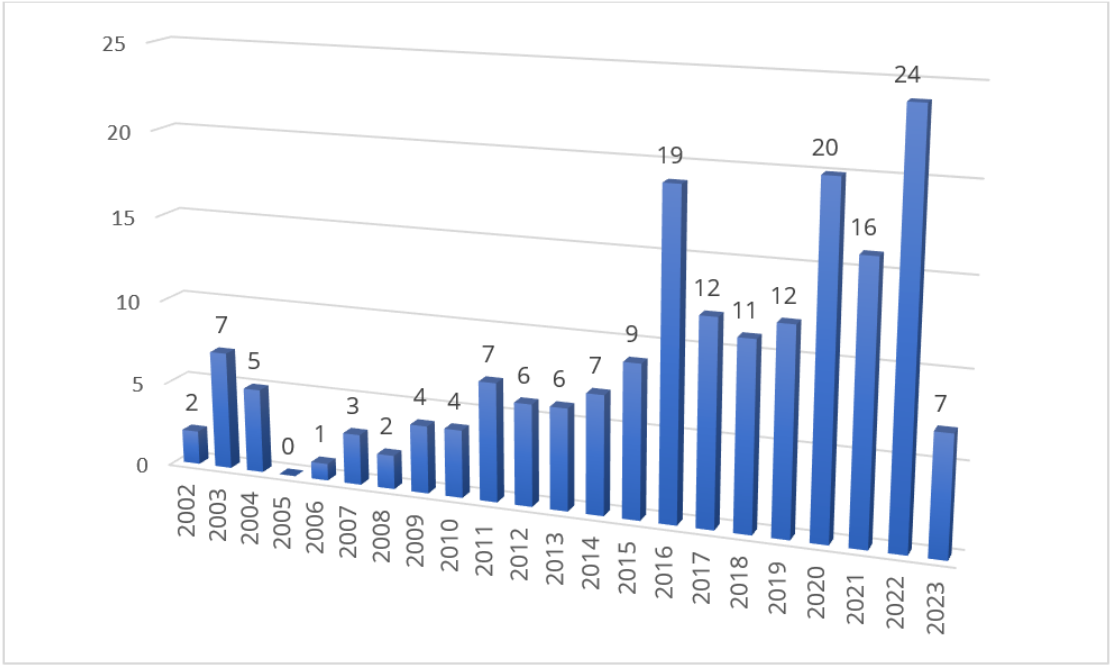
A later Scopus review found relatively few publications during this period. Its search begins in 2002, which is a database coverage boundary, not the origin of AI in science education.[2] The publication timeline also shows how the indexed research base grew after 2015.
Publication growth · Figure 3
The review reports more publications after 2015. The 2023 bar covers only January–May, so it is not directly comparable with a complete year.
Liu and colleagues validated machine scoring for eight inquiry assessment items requiring students to explain phenomena using evidence. The study examined agreement with human scoring for these items, establishing a specific assessment application.[4]
2020
Assessment research takes stock
Zhai and colleagues reviewed 49 studies of machine learning in science assessment. Much of the work concerned scoring accuracy and validity; fewer studies investigated how these systems changed classroom teaching and learning.[5]
2023
Inquiry chatbots and generated materials
Inquirybot used planned dialogue to guide an investigation of sound transmission. In the same year, Cooper explored ChatGPT for science explanations and teaching materials. A scripted inquiry chatbot and a general-purpose generative model offer different kinds of support.[6][7]
2024 · Review of 2013–2023
A broader school-science landscape
Jia, Sun and Looi reviewed 76 studies of AI in primary and secondary science education indexed in Web of Science and Scopus. Their publication graph shows that research output fluctuated but grew across 2013–2023; the 2023 count is incomplete because the search ended in June. The review identified 11 research themes and five categories of AI applications.[3]
Research publications · Figure 2
The 2023 bar is partial because the review's search ended in June 2023.
Figure 2 from Jia, Sun and Looi (2024).[3] Displayed from Springer Nature's article page; select the graph to open the publisher-hosted image.
References
Research behind this page.
Numbered citations in the history and educator guidance sections lead to these papers and reviews.
Tyson, J. (2023). Shortcomings of ChatGPT. Journal of Chemical Education, 100(8), 3098–3101.
Classic ideas in contemporary teaching
How learning theories connect with AI.
Classic learning theories help educators decide what AI should support: students' construction of meaning, their investigation of scientific questions, and guidance suited to their developing understanding. The studies below illustrate these connections in different learning settings.
Constructivism: building and revising understanding
Constructivism views students as active builders of understanding who connect new experiences with existing ideas. AI can support this process through interactive tasks, discussion and feedback that help learners explain and reconsider their reasoning. Zhan et al. (2025) designed an AI- and data-supported teaching model explicitly grounded in constructivism, using the 5E sequence: Engage, Explore, Explain, Elaborate and Evaluate. In a university remote-sensing course, the model combined exploratory activities, collaboration and feedback on learning progress.[5]
For classroom planning, this suggests using AI to prompt students' explanations and reflection while keeping meaning-making in their hands. The study evaluated a combined teaching model against historical cohorts, so its reported improvements cannot establish the separate effect of AI.
Inquiry learning: guiding a scientific investigation
Inquiry-based learning involves asking questions, planning investigations, examining evidence and constructing explanations. Chang, Park and Park (2023) explored this connection through Inquirybot, a structured chatbot that guided fifth- and sixth-grade gifted students as they designed an investigation of sound transmission. Its planned questions and responses supported decisions about the investigation, while the teacher facilitated discussion of measurement methods and evidence.[3]
The classroom implication is to assign AI a clear role in the inquiry process, such as prompting students to identify variables or justify a method. Students still carry out the investigation and evaluate its evidence. This exploratory case study illustrates possibilities and challenges; it does not demonstrate a general improvement in learning, and its structured chatbot differs from a general-purpose generative AI tool.
Zone of proximal development: adapting the support
Vygotsky's zone of proximal development (ZPD) concerns the relationship between what a learner can accomplish independently and what becomes possible with guidance. AI can contribute adaptive support that responds to the learner's progress. Ferguson, van den Broek and van Oostendorp (2022) investigated this idea in a narrative-centred discovery game. Textual instructions were adapted in real time, and learners receiving personalised guidance showed better story and spatial learning and lower cognitive load than those receiving static instructions.[7]
For science teaching, this suggests checking what students can already do and adjusting hints or questions to the difficulty they encounter. The educator should also check subsequent independent understanding. The study supports adaptive guidance in its game setting; it does not establish the same outcomes for every AI tutor or science classroom.
Before sharing AI-generated science content, check its claims, equations, units and assumptions against reliable course material. Consider whether the explanation fits the learning objective and students' age, and whether it could reinforce a misconception or exclude a learner.
Decide what students should still explain or demonstrate themselves. Use the material only when the activity lets you see the scientific thinking you intend to assess. These reminders support professional judgment; they do not certify an AI response.
Six principles for educators
Let professional judgment lead.
A short set of questions to ask before you place generated material in a science learning activity.
01 / ALIGNMENT
Start with the objective.
What should learners understand or do, and how will they show it? Choose an AI role only after that is clear.
Read the explanation
Technological choices make sense alongside the science content and teaching method. The TPACK account treats these forms of teacher knowledge as connected, so begin with the learning goal and select a tool only if it helps students reach it.[8] For example, a generated question is useful when it asks students to explain evidence relevant to the lesson objective.
The educator selects the materials, guides instruction and makes assessment decisions. AI output is a suggestion to review.
Read the explanation
Large language models can assist with preparation and feedback, but their responses can be unreliable and shaped by bias. Educators therefore decide which output is suitable, explain its role to learners and retain responsibility for consequential judgments.[9]
Confirm important claims, equations, assumptions, units and references against course-approved material.
Read the explanation
Fluent writing can hide mistakes. Published chemistry examples document incorrect calculations and fabricated references in ChatGPT output.[11] Rework an answer yourself and compare its claims with dependable disciplinary sources before it reaches students.
Make room for a learner's own prediction, evidence, explanation and independent attempt.
Read the explanation
Use AI dialogue to ask learners to examine and challenge an explanation, not simply receive one. A chemistry teaching study explored ChatGPT-supported critique and students' reported confidence; it does not establish that AI alone improves critical thinking.[10] Ask students to state an initial view, test it against evidence and explain any revision.
Tell learners what help is permitted and how you will assess the scientific reasoning the activity is meant to reveal.
Read the explanation
If a task assesses a student's explanation from evidence, specify whether AI may help with wording, planning or neither. Automated scoring research addresses selected response types and does not remove the need to interpret a student's reasoning in context.[4][5] Ask for a record of permitted assistance when relevant.
Do not make a paid tool, personal device or account a hidden requirement. Offer a meaningful equivalent route.
Read the explanation
Opportunities from language models depend on access, digital skills and how systems serve different learners. The education literature raises fairness and inclusion as design concerns.[9] Provide a comparable non-AI route and check that both routes let students meet the same objective.